The Case for a Community Bank Podcast (And What Most Banks Get Wrong About It)
Most bank podcasts die by episode 10. Here's what the ones that last do differently, and why the format is built for community banking.
Northwestern Bank in Chippewa Falls, Wisconsin has published more than 200 episodes of a podcast called Banker with a Beer. The host, Jerry Kuehl, is a senior vice president at the $700M-asset bank. He interviews mayors, school superintendents, airport managers, and brewers. They drink a local beer on the air. New episodes drop every Thursday morning.
That is the entire marketing machine. No agency. No production company on retainer. And it has outlasted almost every content program a community bank of that size could run.
If you want to understand why a podcast is one of the sharpest marketing investments available to a community bank right now, and why most banks still fail at it, start there.
The format is built for the business you’re actually in
Community banks sell relationship. That is the whole pitch. It is the thing fintechs cannot price-match and megabanks cannot scale. And audio is the only content format that reproduces relationship at a distance.
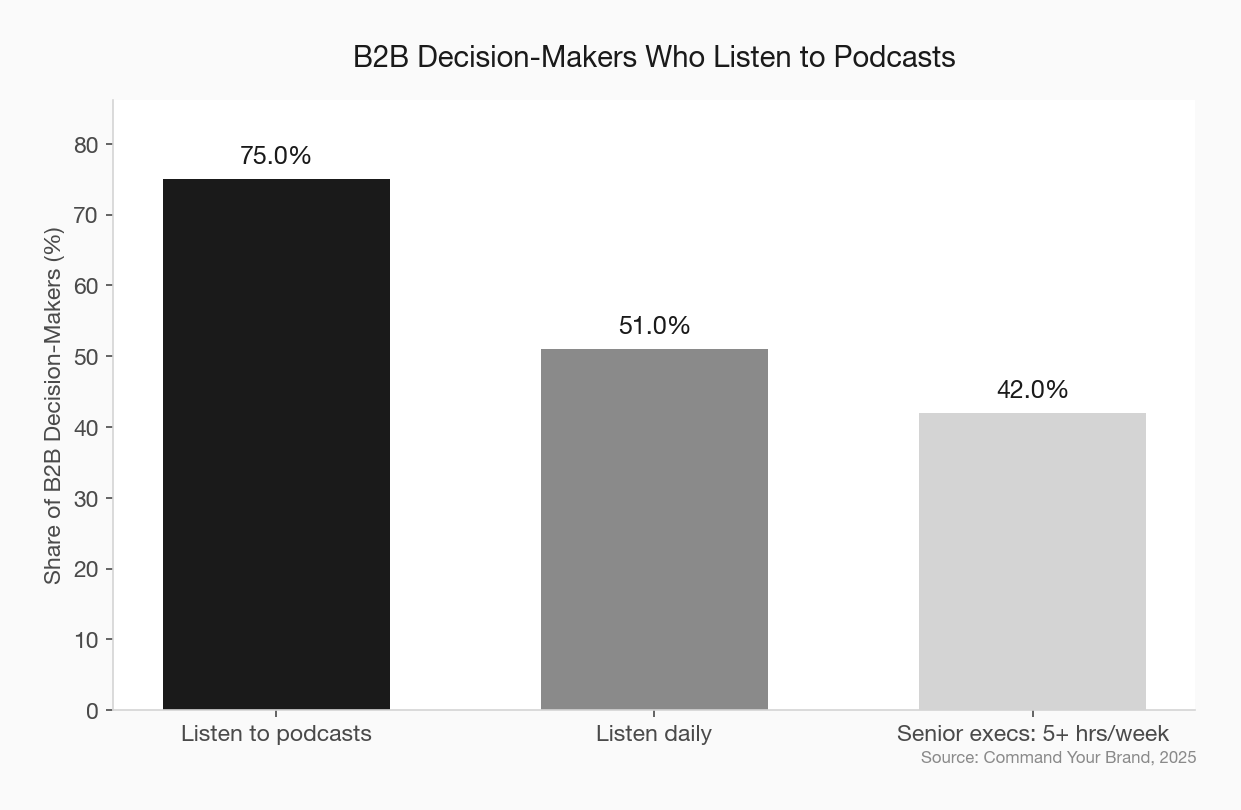
The numbers back this up. 75% of B2B decision-makers listen to podcasts, and 51% listen daily. 83% of senior executives listened to a podcast in the past week, and they are twice as likely as the general population to consume at least five hours of podcasts per week.
The people you want to bank, business owners, CFOs, local leaders, are in the audience. They are not scrolling your Instagram. They are listening to 45 minutes of audio on the drive to a job site or a board meeting.
The other format stat that matters: B2B podcasts see completion rates above 80%. Video sits around 12%. That is not a small gap. It is the difference between producing something people actually finish and producing something they flick off after a headline.
Why most community bank podcasts die
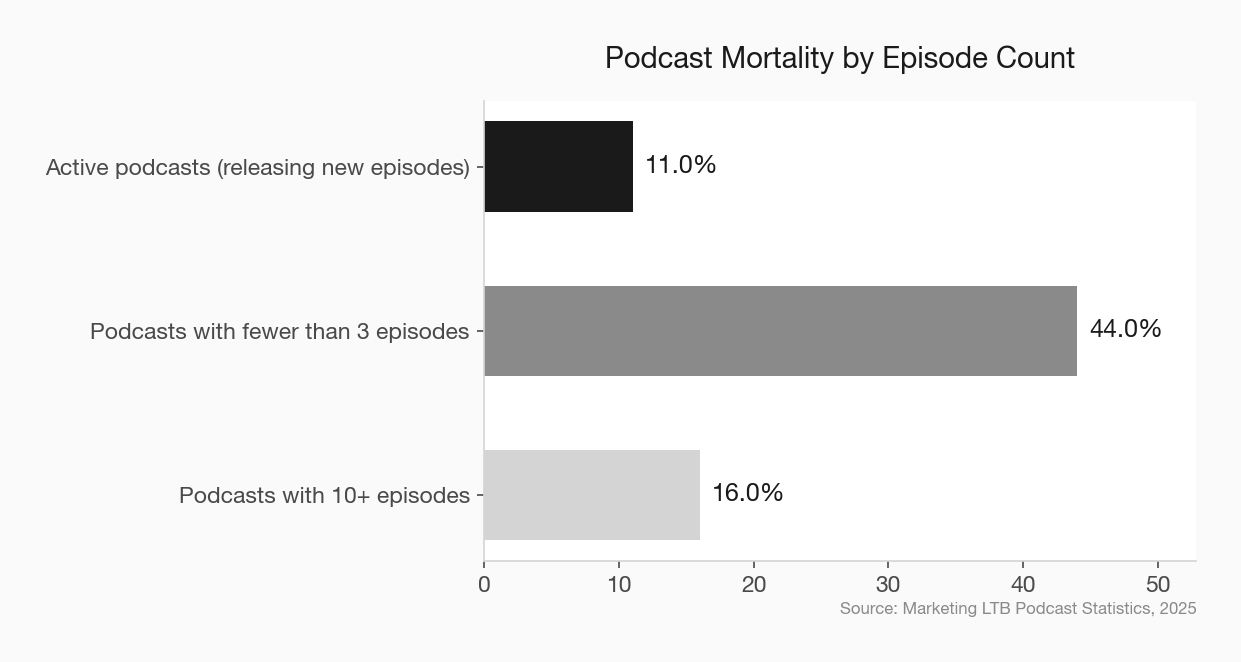
Here is the uncomfortable truth. 44% of all podcasts have fewer than 3 episodes. Most shows podfade around episode 7. Out of roughly 4.5 million podcast shows indexed globally, only 10 to 11% are still actively releasing new episodes.
The bank podcast graveyard follows a pattern. It goes like this.
- A marketer or CEO pitches the idea. Everyone loves it.
- Someone builds a logo, buys a microphone, and launches with fanfare.
- Episodes 1 through 5 feature the executive team talking about the bank.
- By episode 6, the person running it has a day job and an empty guest pipeline.
- By episode 10, the feed goes quiet. It never comes back.
I have seen this play out at roughly a dozen community banks. The cause is always the same. The show was built around the bank instead of around the audience.
What Banker with a Beer gets right
Go listen to three episodes of Jerry Kuehl’s show. Here is what you will notice.
The bank is barely in it. The podcast is about the Chippewa Valley. It is about economic development, housing issues, local business, and the people running institutions the community depends on. Northwestern Bank sponsors and hosts the conversation. It does not dominate it.
The guests are real local figures. School superintendents. Mayors. The guy running the regional airport. These are people whose voices business customers want to hear. They are not canned bank executives reciting mission statements.
The pace is sustainable. A single SVP plus a media partner (they record with Eau Claire Home Radio) can keep this going weekly because the production model is designed for that. It is a conversation with a beer. Not a documentary.
It has a personality. The beer is not a gimmick. It is a permission structure. It signals that the show is informal, civic, and local. It gives the host and guest a legitimate reason to relax and talk like humans.
That combination, local subjects, local voices, sustainable cadence, and a format that grants permission to be a person, is what separates a podcast that runs for five years from one that runs for five weeks.
The three things most banks get wrong
Mistake one: making the show about the bank. Nobody wants to hear your SVP of commercial lending talk about your SBA process for 28 minutes. A community bank podcast should be about the community the bank serves. The bank’s role is host, not protagonist. If the word “we” shows up more than the word “you” in a typical episode, the show is pointed the wrong way.
Mistake two: building for scale you don’t need. Community bank podcasts do not need a production studio, a media team, and a publicist. The entire reason the format works is that it is low-fi, personal, and local. Builtwell Bank in Chattanooga runs its podcast, A Well-Built Podcast, by the same principle. Episodes are tied to customer interests and promoted with QR codes on printed materials the bank is already distributing. That is the whole marketing stack.
Mistake three: treating publishing cadence as optional. Consistency is the single biggest predictor of podcast survival, and the thing community banks most frequently compromise on. A monthly show that misses a month is dead. A weekly show that drops to bi-weekly is dying. The cadence you commit to must be a cadence you can hit during the two worst weeks of your year. For most community banks, that is every other week, not weekly. Be honest about it upfront.
What to do if you’re going to do this
Here is the playbook I would run at a community bank considering a podcast.
Pick a single host who owns the show. Not a rotating cast. Not a committee. One person whose job description has “host the podcast” written into it and whose performance review includes cadence. That person should be senior enough to land guests and junior enough to actually execute week to week. A VP of marketing or an SVP of commercial lending with good interview instincts is the right profile.
Define the show in one sentence. “Conversations with business owners about what is actually happening in [your market].” “The people and projects shaping [region].” “How small businesses in [county] are navigating” the actual local economy. If you cannot write that sentence, do not start recording.
Build a 12-guest pipeline before episode one. This is the single highest-leverage thing you can do. Most pod fades happen because the show runs out of guests in month three. If you start with a confirmed pipeline of the first 12 guests and a waiting list of five more, you have bought yourself six months of runway.
Commit to 26 episodes or do not launch. Bi-weekly for 12 months. That is the minimum commitment that produces enough content for search discovery, enough repetition for audience habit, and enough material to build highlight clips for social. Anything less is a hobby.
Pair it with a media partner. Record at a local radio station, a production house, or a college communications program. This is the single best investment a community bank can make in a podcast. It offloads the production burden, raises the audio quality floor, and creates a distribution partner who wants the show to succeed.
Use the clips, not just the episodes. A 45-minute conversation yields 6 to 10 short clips that are far more shareable than the full episode. Those clips, pinned to LinkedIn, Instagram, and the bank’s website, do more marketing work than the full episode ever will. why LinkedIn is an underused channel for community banks
The business case nobody makes explicitly
A community bank podcast is a business development engine disguised as a content program. The right guests become deeper customers. The customers who are already with the bank become referral sources. The non-customers who listen become familiar with the bank without being pitched.
Jerry Kuehl has spent 200+ hours in recorded conversations with the most influential people in the Chippewa Valley over five years. That is a level of relational access a community bank’s commercial team could never buy directly. The show pays for itself on loan relationships and deposit retention that never hit a marketing attribution report.
The average guest-to-client conversion rate on B2B podcasts is around 10%. Put that against a cost per lead from paid search or a deposit promotion and the math is not close. the 3 marketing metrics that actually matter for community banks
The bottom line
Most community bank podcasts fail because they are built as a content project instead of a relationship asset. The ones that last are run by a senior person, about the community, at a cadence the host can actually hit, with guests who matter locally, and with enough runway to survive the first six months before anyone is listening.
That is a much smaller list of requirements than most banks think. It is also a much shorter list than any other marketing channel this effective. If you have one SVP willing to host, one media partner, and a 12-guest pipeline, you have a marketing moat a fintech cannot copy and a megabank will not bother to build.
Build the show. Commit to the cadence. Keep the bank out of the frame. That is the entire playbook.