Video Marketing for Community Banks: What Works, What Doesn't, What's Worth the Budget
82% of marketers report good ROI on video. Most community bank video fails. Here's what works, what doesn't, and what's worth the budget.
Eighty-two percent of marketers say video delivers a good ROI. Sixty-three percent of consumers say a short video is how they most want to learn about a product. Landing pages with embedded video see up to 86% higher conversion rates. And only 7% of bank marketers plan to increase their TV budgets in 2026, which tells you how badly the industry has misread what video is supposed to be doing.
Here is the short version. Most community bank video is a commercial problem disguised as a marketing program. A thirty-second spot about “how much we care about your community,” shot by a local production company for $18,000, played twice on local cable, and posted once to Facebook where it gets nine likes. The banks winning with video are not making commercials. They are making content.
That distinction is the entire post.
The Spend Problem
If your bank has a video budget, it is probably allocated to the wrong things.
The industries beating banks in digital are putting close to 15% of their marketing budget into digital video. The bank numbers are much smaller, and most of what does get spent goes to legacy broadcast or a polished annual TV spot. Broadcast attention is declining. Streaming and short-form are where viewing has moved. The bank marketing budget has not moved with it.
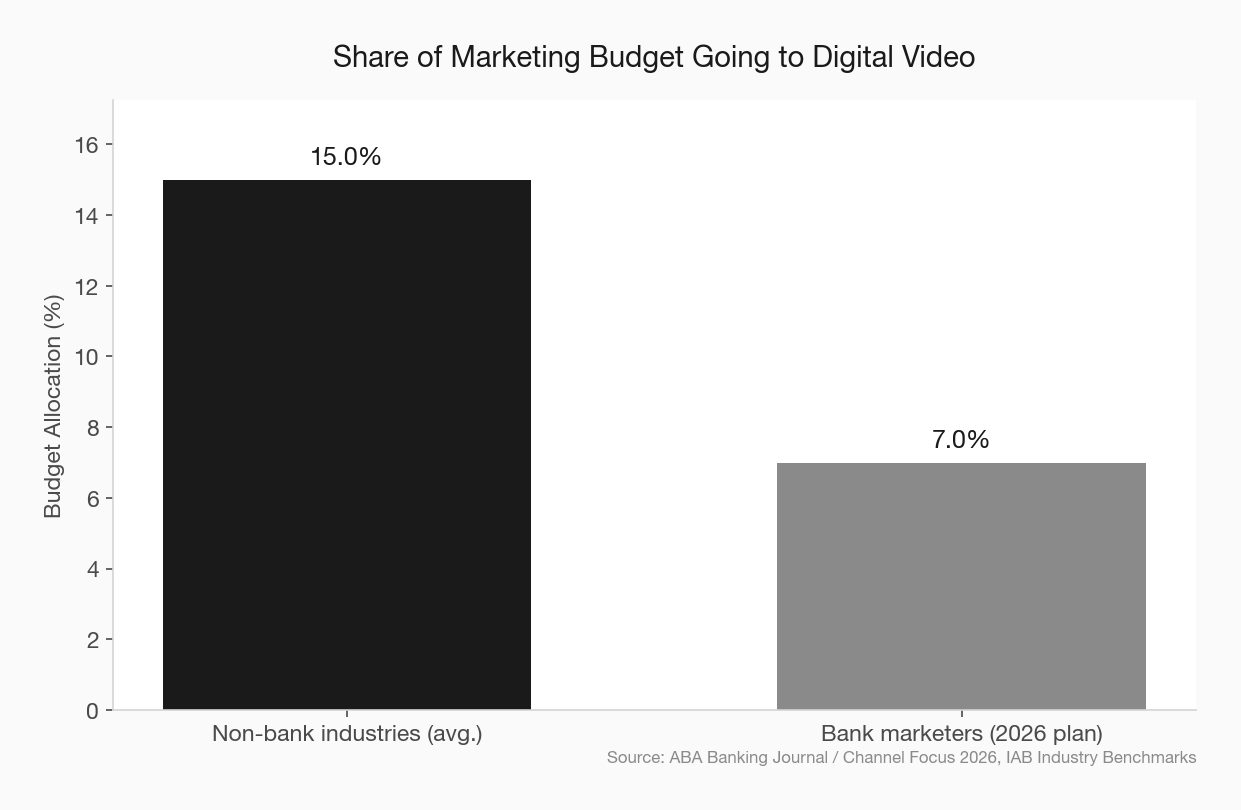
That gap is a strategic opening for community banks that move early. A few already have. Most haven’t.
What Community Banks Get Wrong
Three patterns show up repeatedly, and if you read this and recognize your own bank in them, that is the point.
Over-producing. A local production company delivers a polished commercial. It looks expensive because it is expensive. It also looks like every other bank commercial, because it was made by someone who makes bank commercials.
Repurposing broadcast creative for social. A thirty-second TV spot trimmed to fifteen seconds and posted vertically to Instagram is not a social video. The format, pacing, and framing of a broadcast ad are wrong for feeds. Engagement on that content rounds to zero. You can check this yourself in five minutes.
Treating video as campaigns, not as content. A campaign runs and ends. Content is continuous. YouTube, LinkedIn, Instagram Reels, and TikTok reward weekly cadence. The bank that posts twelve videos a year is not in the conversation. The bank that posts twelve videos a month starts to compound.
What Actually Works
Five formats earn their keep for community banks. Everything else is optional.
1. Banker on camera. Sixty to ninety seconds of your head of small business lending, a mortgage officer, or a branch manager explaining one specific thing. Not a product pitch. A question customers actually ask. “What do I need to bring to apply for an SBA loan?” “How does our HELOC compare to what you’re seeing online?” “What’s the difference between a CD ladder and a money market?” Real people, named, shot on a smartphone. Fidelity’s TikTok team has built an audience using this approach and they are not using a studio.
2. Customer story. Two to three minutes, interview format. A real business owner, farmer, or homeowner describing what your bank did for them. Marion Community Bank has built a testimonial program around exactly this idea, positioning customers as the hero and the bank as the supporting cast. The video is not about you. It is about the person.
3. Local event coverage. Parade sponsorship, ribbon cutting, food drive, chamber mixer. Thirty to forty-five seconds, natural sound, a few B-roll shots, one sentence of context. This is the fastest-compounding video asset a community bank has. It proves the community-focus claim that every bank makes in its homepage copy.
4. Market and rate commentary. Once or twice a month, sixty to ninety seconds of your CEO, CFO, or treasurer describing what’s happening in local lending, deposit pricing, or the broader rate environment. Positioned correctly, this becomes the reason business owners follow your bank’s LinkedIn page.
5. Educational shorts. Thirty to sixty seconds on topics customers are already searching. “Should I refinance?” “What is the difference between checking and money market?” “How do I use Zelle safely?” These are search-indexed assets that earn traffic for years after publication.
That is the whole list. None of these require an agency.
The Cost Structure Has Collapsed
The shift that matters most for community banks: video production costs have fallen through the floor.
Professional short-form social clips that used to run $3,000 to $5,000 per piece now run $1,000 to $3,000 fully produced, and most community banks can cut that in half by handling production in-house with a smartphone, a $60 lavalier mic, and a $20-per-month editing subscription.
AI-assisted tools have pushed per-minute production costs from roughly $4,500 to around $400 according to 2026 industry data. That does not mean you should be generating AI-avatar clips of your loan officers. It does mean captioning, B-roll sourcing, thumbnail creation, and editing can be done by one staff member in half a day instead of shipped to an agency for a week.
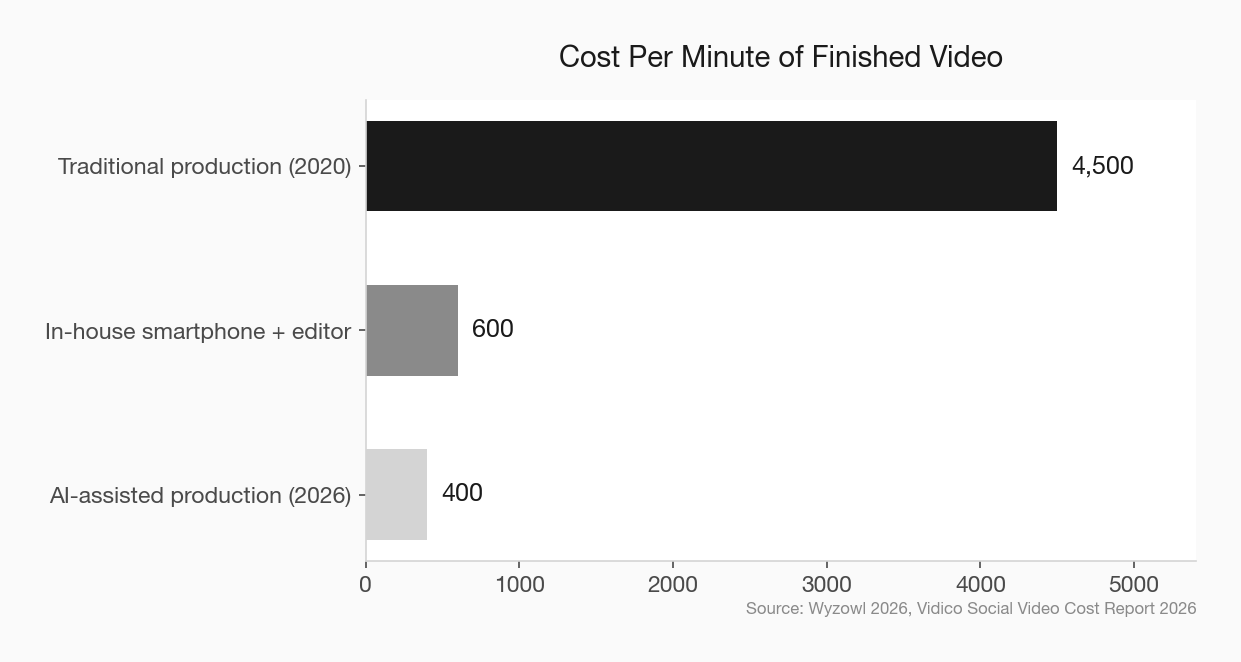
The economics now favor the bank that ships frequently over the bank that ships once a year with high polish.
banker-on-camera starter guide
What To Stop Spending On
This is where I will take a position. Most community banks should stop spending on:
- Thirty-second TV commercials. Unless you have specific data showing local cable buys are driving account opens (almost none of you do), this is legacy spending that survives by inertia. Kill it and redirect the budget.
- Polished brand anthems. A three-minute cinematic piece about “what community means” is not doing work. Nobody is watching it past the second cut. It exists so the board can say “have you seen our new commercial?”
- Agency-produced animated explainers. You do not need a $12,000 motion graphics video to explain your mobile app. A banker holding the phone and showing the app is more effective and costs nothing.
- Stock footage. Any video that could have been produced for any other bank in the country is doing nothing for your brand. Put real people from your actual market on camera, or do not produce the video.
The Real Budget
For a community bank under $1B in assets, a sensible 2026 video budget looks like this:
- $5,000 to $10,000 one-time for equipment. Smartphone gimbal, lavalier mic, ring light, simple backdrop, editing software subscription for a year.
- A half-time internal producer, which in most banks is existing marketing headcount reassigned. Someone on the team owns the video calendar.
- $500 to $2,000 per month for occasional freelance editing, captioning tools, and music licensing.
Under $30,000 a year for a weekly cadence across YouTube, LinkedIn, Instagram, and Facebook. The bank spending $40,000 on one TV spot is getting worse results than the bank spending $30,000 on a year of weekly content. This is not close.
Where to Post
A quick note on distribution, because format decisions follow the platform.
LinkedIn is where banker-on-camera clips, market updates, and B2B customer stories belong. Business owner audience. Vertical, captioned, sixty to ninety seconds.
YouTube long-form holds your full customer stories, educational deep-dives, and recorded webinars. Search traffic compounds for years on this platform and almost no community bank has an active channel.
YouTube Shorts, Instagram Reels, and TikTok are for educational shorts and fast banker-on-camera. Vertical, under sixty seconds, text-on-screen, the hook has to land in the first two seconds or viewers swipe.
Facebook is for event coverage, community content, and testimonials. Still the most-used platform among customers over 45, and that is a large share of your deposit base.
You do not need to be on all of them. Pick two, do them weekly for six months, then add a third.
community bank social media playbook
The Measurement Most Banks Skip
Publishing a video and checking how many likes it got is not measurement. The metrics that actually matter:
- Watch time and retention. If viewers are dropping off at three seconds, your hook is broken. Fix the first three seconds.
- Click-through to a landing page or form. Every video should either end with a clear call to action or link in the post. Measure whether that link is clicked.
- New accounts opened attributable to video. A unique promo code, a dedicated landing page, or a UTM-tracked URL is how you tie opens back to content. Most community banks have no tracking in place. That is the first thing to fix.
- Search queries surfacing your videos. YouTube’s creator dashboard gives you this data for free. Use it to find the content people were actively looking for when they landed on you.
A video program without attribution is a guess. A video program with attribution is a channel.
The Calendar That Works
The simplest cadence I would recommend to any community bank starting tomorrow:
- Monday: banker-on-camera clip. One topic, sixty to ninety seconds. Posted to LinkedIn and Instagram Reels.
- Wednesday: educational short. Thirty to sixty seconds, vertical. Posted to Reels, YouTube Shorts, and TikTok if you’re there.
- Friday: community content or customer story. Longer format allowed. Posted to Facebook and YouTube.
Three videos a week. One primary shooter. Most of the shooting compresses into two ninety-minute blocks per week. After three months, you have thirty-six videos on the internet, each of which keeps earning views, search traffic, and occasional conversions for years.
Compare that to the bank that spent the same money on one thirty-second commercial and a Facebook ad buy.
On Personalized Video
If you have a meaningful digital deposit base, personalized video is starting to become viable at community bank scale. Bank of America and T. Rowe Price have run personalized video programs through vendors like SundaySky with measurable lifts in engagement, retention, and AUM growth. The technology is not cheap yet, but the vendor market is maturing and community-bank pricing will follow. Do not lead with this. Keep it on the radar for 2027.
community bank content calendar template
The Takeaway
Video is not a production problem. It is a posture problem. The community banks doing this well treat their bankers as on-camera talent, their events as content fodder, and their platforms as something that requires a weekly cadence. They stopped making commercials. They started making content.
Your competitors are not the other community banks in your county anymore. Your competitors are Chime’s TikTok, SoFi’s YouTube, and the independent mortgage broker three miles down the road who shoots a daily Reel from her car. Those are the people winning attention in your market. The answer is not to outspend them. You can’t. The answer is to outwork them.
Show up three times a week with a real person, a real story, and a phone. In twelve months you will be unrecognizable on the platforms that actually drive account opens. In twenty-four you will own a local content position that no fintech can replicate because they are not from here and you are.
That is the opportunity. It is sitting on your marketing team’s desk. Pick it up.