Your Google Business Profile Is a Marketing Asset. Treat It Like One.
Complete Google Business Profiles surface 80% more often and convert 3.2x better. Most community bank profiles are abandoned. Here's the 30-minute fix.
A fully populated, verified Google Business Profile surfaces in search 80% more often than an incomplete one, generates four times more website visits, and converts 3.2 times more often once people land. That is the entire case. A community bank that is not actively managing its GBP is voluntarily giving up a marketing asset that already exists, already ranks, and already influences a disproportionate share of local buying decisions.
Most community banks are doing exactly that. Branch manager claimed the listing in 2017, uploaded three photos, set the category to “Bank,” and never logged back in. Meanwhile, the fintech mortgage broker three miles away has 212 reviews, 40 photos, weekly posts, and sits at the top of the local pack for every query that matters.
This is not a technology problem. It is a discipline problem. And it is the single most fixable gap in community bank marketing.
The Economics of the Listing
The Google Business Profile is the storefront that 83% of consumers use to read reviews before choosing a business. It is the widget that shows up before your website in a search result. It tells Google, a directions app, and a voice assistant whether you are open, what you do, and whether you are worth recommending. It is also almost entirely free. The only cost is attention.
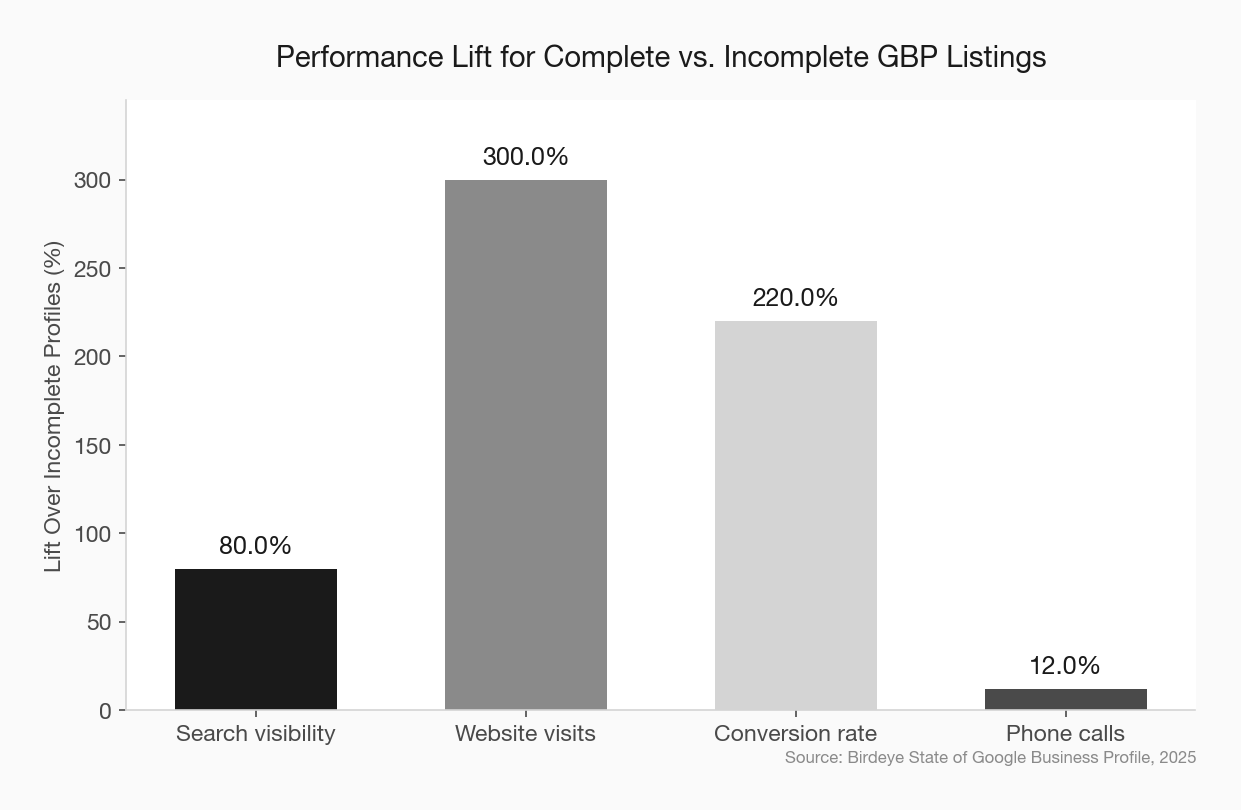
Read that chart carefully. A complete profile does not get 80% more results. It gets 80% more visibility, 300% more website visits, 220% more conversions, and 12% more calls. That is a combined impact that most marketing line items cannot match, and it is sitting behind a login most community banks have not touched in months.
What Google Actually Weighs
Local SEO practitioners rank the primary GBP category as the single most important signal for local pack rankings. Not a top-five factor. The top factor. Most community banks still have theirs set to the generic “Bank” category, which Google treats as a catch-all that sends your listing into competition with every megabank, ATM, and crypto kiosk within 10 miles.
The correct answer in most cases is “Community Bank” as the primary, with secondary categories that map to your actual products: Mortgage Lender, Small Business Lending Service, Commercial Bank, Business Banking Service, Financial Planner if you have a wealth arm. Every secondary category is a new query surface.
Beyond category, Google’s local algorithm weighs three signal families: relevance (category, services, description, attributes, keywords in reviews), prominence (review volume, response rate, citation consistency, brand mentions), and proximity (where the searcher is standing — the one factor you cannot control). Two out of three are directly in your hands. Neither requires a new platform, a consultant, or a board meeting.
The Fields Every Community Bank Gets Wrong
Open your GBP dashboard. Walk through these in order. This is the 30-minute fix.
Primary category. “Community Bank” if your listing offers it. If not, “Bank.” Do not leave it as the first thing Google suggested in 2015.
Secondary categories. Up to nine. For every product line that matters: Mortgage Lender, Small Business Lending Service, Commercial Bank, Investment Service, ATM.
Business description. 750 characters. Most community banks have 40 words of heritage boilerplate. Write something specific — who you serve, what you actually do, which towns, what your reputation is for. Heritage without specifics is wasted space.
Services. Individually list every product: checking, savings, CDs, money market, auto loans, home equity, mortgages, SBA lending, treasury management. Each entry is searchable. Most community bank GBPs list zero.
Hours. Regular, holiday, drive-through, lobby. Wrong hours damage trust. Update holiday hours three times a year.
Appointment booking and service area. Add the booking URL if you accept appointments. Define your service area if it extends beyond the branch address. This is how you show up in nearby ZIP codes.
Attributes. Wheelchair accessible, appointment required, online appointments, veteran-owned, family-owned, women-led. These surface in filtered searches and nobody is using them.
Photos. Twenty plus per branch, refreshed quarterly. More on this below.
Thirty minutes, one person, one tab open. That is the baseline any community bank should hit this month.
Reviews Are a System, Not a Favor
The average local business has 39 Google reviews. The average business ranking in positions 1 through 3 has 47. That does not mean eight more reviews buys you the top spot. It means review volume is a prerequisite, not a bonus. Below the floor, you do not rank. Above it, other signals decide the order.
Eighty-one percent of consumers now say reviews are important or very important when choosing a financial services provider, up from 66% in 2022. The trend line is not ambiguous.
The community banks that compete on reviews run a three-part system. There is nothing clever about it, which is why it works.
First, ask systematically. Every account opening, every loan closing, every meaningful service touchpoint ends with a staff member sending a direct text-message link to the customer’s Google review page. Not a QR code. Not a URL printed on a receipt. A link, sent from a person, while the experience is fresh. Removing friction is the whole game. Businesses that actively ask see review velocity 5x to 10x what passive banks see.
Second, respond to every single review. Positive, negative, three-star, weird one-liner. The response is not for the reviewer. It is for the next person reading reviews three months later. Professional, specific, signed with a real name. Businesses that reply to all reviews have 2025 conversion rates north of 5.1%, which is meaningfully higher than those that do not respond.
Third, set a floor and a target. Fifty reviews is the minimum threshold where Google starts treating you as a legitimately prominent local business. One hundred is where you start to look dominant. Most community banks are stuck in the single digits or low teens because nobody is responsible for the number going up.
community bank review generation playbook
GBP Posts Are the Newsletter Google Gives You for Free
GBP posts are the most underutilized feature on the platform. Short updates, 300 to 600 characters, with a photo and a call-to-action link, that appear directly inside your listing in search results. Posts older than three months get deprioritized. Weekly is optimal; monthly is the floor.
What should community banks post? The same content that makes your social feeds worth following, reformatted:
- Rate updates (CDs, HELOCs, business loans) with a link to the product page.
- Community sponsorships and events with real event photos, not a logo sheet.
- Team spotlights with a photo and a personal quote.
- Mobile app and product updates.
- Seasonal campaigns — tax season, home-buying season, small business month.
One post a week. Twenty minutes. Content that already exists for social and email gets reused on the GBP. Cheapest compounding marketing in the building.
The Q&A Section Is a Trap You Can Control
Google lets any user post a question on your GBP, and any other user can answer it. On an unattended community bank listing, you will routinely find customer questions answered by total strangers — sometimes incorrectly, sometimes with outdated information, occasionally with a competitor’s name.
Two things to do immediately. First, seed the top 10 questions yourself. Ask them from a team member’s personal Google account, then answer from the business account. Hours, parking, drive-through availability, product availability, appointment scheduling, minimum deposit amounts, holiday closures. These are the questions customers are typing into Google, and owning the answers is free content with high search value.
Second, set a weekly reminder. New user-submitted questions appear regularly. Answer within 48 hours from the business account. Ten minutes a week. The bank that does this has a clean, authoritative Q&A panel. The one that does not is publishing inaccurate information on its own storefront.
community bank Google Business Profile audit
Photos Are the Differentiator
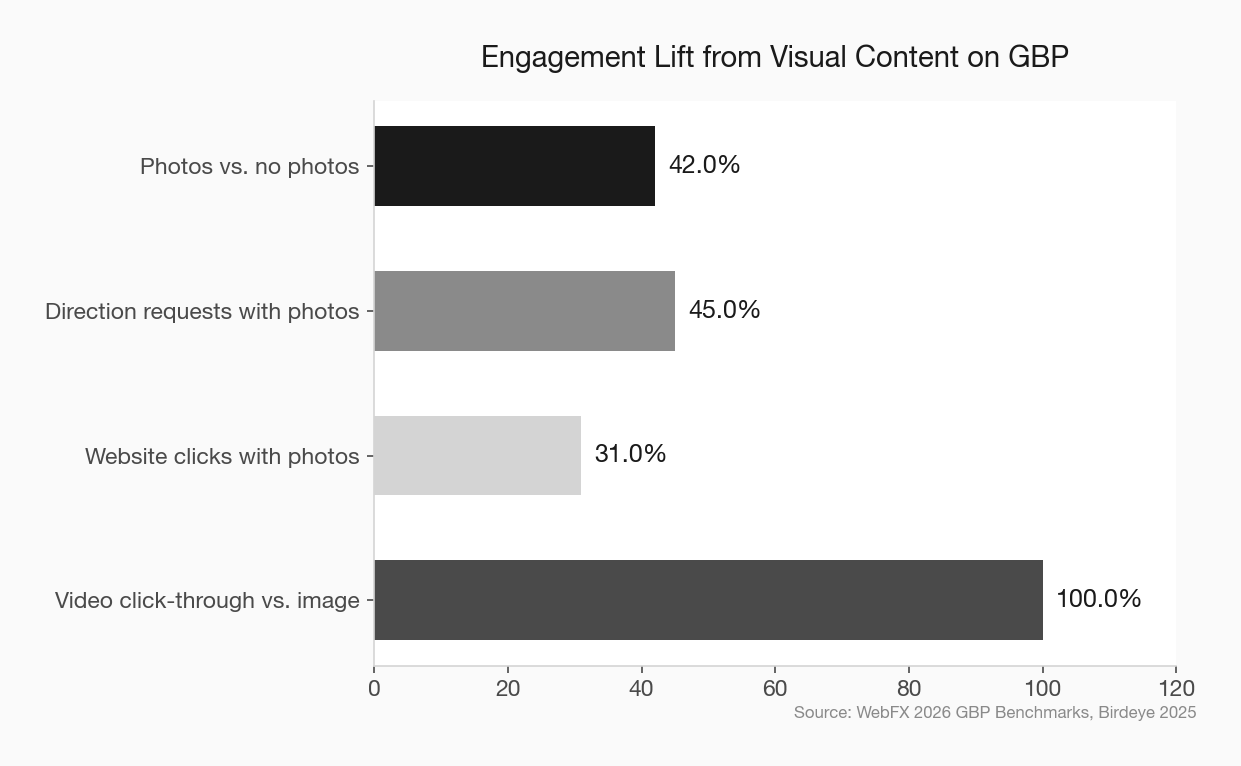
Profiles with photos get 42% more engagement than those without, 45% more direction requests, and 31% more website clicks. The effort is minimal, yet the median community bank GBP still has three photos from 2019, all of the branch exterior.
The baseline a community bank should hit, per branch:
- Exterior from the street, at the angle a customer driving past would see.
- Lobby interior with the teller line and any seating areas.
- Drive-through, clearly labeled.
- At least two staff photos — real people, named, customer-friendly expressions.
- Signage close-up, clearly showing the bank name.
- Community events, sponsored teams, ribbon cuttings.
- Product area shots for mortgage, business banking, or wealth offices.
Twenty photos minimum, refreshed each quarter. A smartphone and thirty minutes per branch is enough.
Video is the next frontier. On GBP, videos get twice the click-through rate of images and drive 20% more conversions. A 30-second clip of your head of small business lending talking about local businesses does more for local conversion than most banks’ entire paid search budgets.
What to Measure
The GBP dashboard gives you the data for free. The metrics that matter:
- Profile searches: discovery queries (found via category or keyword) vs. direct (found by name). A healthy ratio tilts toward discovery. If 95% is direct, you are not ranking for anything new.
- Profile actions: calls, direction requests, website clicks, appointment bookings. Any one trending up is working.
- Review velocity: new reviews per month. Target 10 per branch.
- Post engagement: if posts get zero clicks, your content is bad. Fix it before blaming the feature.
- Q&A response time: target under 24 hours.
Check these weekly. If you are not, you do not get to claim your GBP is not working.
community bank marketing metrics scorecard
The Weekly 15-Minute Habit
The 30-minute fix happens once. The compounding return happens when the GBP becomes a weekly habit. The rhythm:
- Monday: scan and respond to new reviews. Five minutes.
- Tuesday: publish one GBP post. Five minutes if content is already written for another channel.
- Wednesday: check Q&A, answer new questions. Two minutes.
- Thursday: upload one or two new photos. Two minutes.
- Friday: review the dashboard, log one observation. One minute.
Fifteen minutes a week, one person, permanently. The bank that does this for a year owns the top of the local pack for the queries that matter. The bank that does not will keep wondering why the fintech lender across town keeps eating its small business funnel.
The Listing Is a Marketing Asset. Start Treating It Like One.
Your website is a marketing asset and you pay an agency to manage it. Your social accounts are marketing assets and someone on staff posts to them weekly. Your Google Business Profile is a bigger, cheaper, more measurable asset than either — and it is sitting in an abandoned dashboard because nobody decided it was their job.
Assign it. Put it in a job description. Budget the fifteen weekly minutes. The reason your bank does not rank in the local pack is not that Google does not understand you. It is that you have not bothered to tell Google what you do, who you serve, and why anyone should trust you. That conversation happens on the GBP. Start having it.
community bank local marketing sprint