Local SEO for Banks: The Most Underused Marketing Channel in Financial Services
46% of Google searches are local. 76% of "near me" searchers visit within a day. Most community banks rank nowhere for their own ZIP code. Here's the fix.
Forty-six percent of every Google search has local intent. Another 1.5 billion “near me” searches happen every month, and 76% of those searchers walk into a business within 24 hours. For a community bank in a defined geographic footprint, this is the most favorable marketing math in the industry – and most banks are ignoring it.
Type “bank near me” into Google from inside your branch. If your bank is not in the top three results, someone has already taken a seat at your table. In most small markets, that someone is a regional competitor, a credit union, or worse – a Chase branch that happens to be six miles closer. The local pack is not a reward for being around a long time. It is a ranking algorithm, and it responds to specific inputs.
The good news: the inputs are not secret, they are not expensive, and community banks are uniquely positioned to win them. The bad news: almost nobody is doing the work.
The Local Pack Is the Whole Game
When someone searches for a bank in a local context – “bank near me,” “small business loan [city],” “checking account [county]” – Google almost always returns a local pack. Three results, a map, phone numbers, directions, reviews. That block is what users look at.
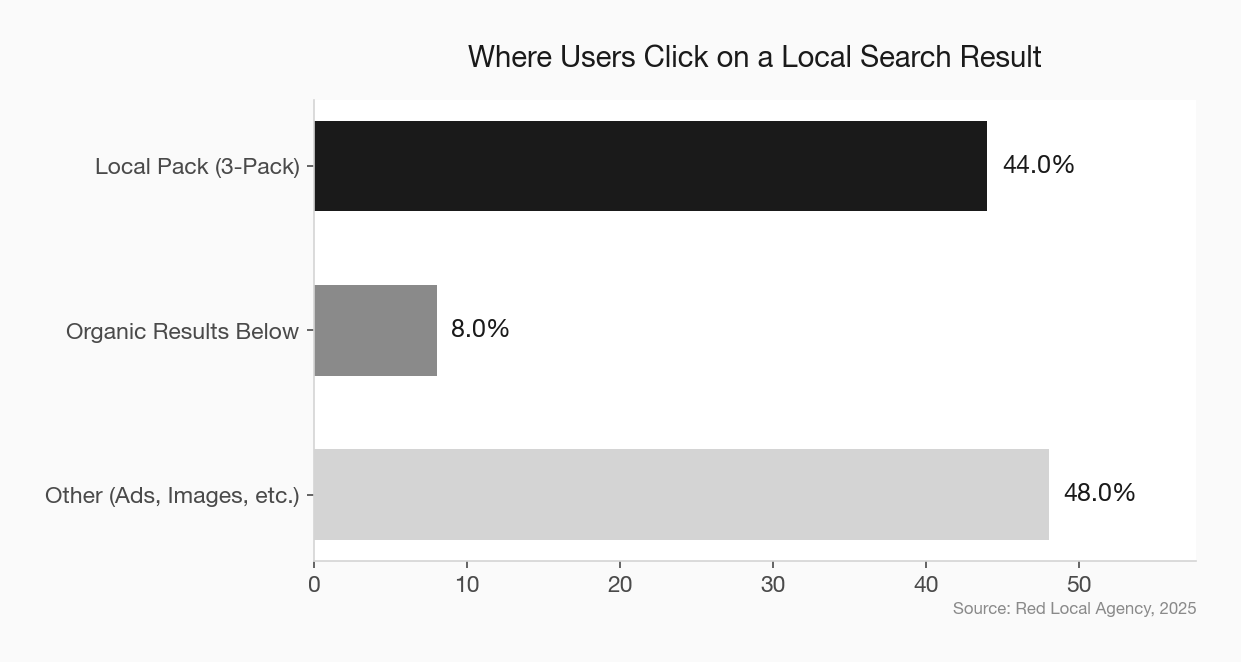
Forty-four percent of users click a listing in the local pack. Only 8% scroll past it to the organic results beneath. If you are not in the pack, you are competing for 8% of the clicks on a query that already signals high purchase intent.
Here is the kicker: businesses in the 3-pack get 93% more actions – phone calls, website clicks, driving directions – than businesses ranked in positions 4 through 10. The drop-off is not linear. It is a cliff.
That is the prize. Now the work.
What Google Actually Uses to Rank You Locally
Google’s local algorithm weighs three factors: relevance, proximity, and prominence. You cannot control proximity – a searcher’s physical location is what it is. You absolutely can control the other two.
Relevance is how well your Google Business Profile matches what someone searched for. Primary category, services listed, business description, attributes. This is a configuration exercise, not a creative one.
Prominence is a composite of review volume, review quality, local backlinks, citation consistency, and brand mentions across the web. This is where most community banks lose. They have been around for 80 years and have 11 Google reviews. A fintech lender with a pop-up website has 340.
Here is the strategic lesson most community bank executives miss: Google does not care that you have been in the community since 1947. Google cares whether the signals on the open web say so. Heritage without digital evidence is invisible in the local pack.
The Google Business Profile Fixes That Actually Move Rankings
Most community bank GBP listings are a mess. They were set up by a branch manager in 2015, have not been updated since, and list a category of “Bank” when Google offers more specific options like “Community Bank,” “Mortgage Lender,” “Small Business Lending Service,” or “Credit Union.”
The primary category on your GBP is the single most important local ranking factor. Not close. If your bank is set to “Bank” when it could be the more specific “Community Bank” – and your competitor set theirs correctly – you are starting the race 10 yards behind.
Here is the list, in priority order, of what every community bank should fix on its GBP this month:
- Primary category. “Community Bank” if available, otherwise “Bank.” For each product line with volume, add a secondary category: Mortgage Lender, Small Business Lending Service, Commercial Bank, Business Banking Service.
- NAP consistency. Name, address, phone number. It must match your website exactly, down to the “Inc.” or the ampersand. Inconsistencies across directories destroy prominence signals.
- Services. List every service individually – checking, savings, CDs, auto loans, mortgages, commercial lending, treasury management. Each becomes a searchable attribute. Most banks list zero.
- Photos. Upload 20+ photos. Interior, exterior, staff, community events. Businesses with 100+ photos get 520% more calls than the average. Most bank profiles have 3 photos from 2019.
- Hours and holiday hours. Incorrect hours kill trust and Google knows it. Update for every federal holiday.
- Q&A. Google lets users ask questions on your profile, and other users can answer. If you are not monitoring this, customers are getting answers from strangers. Pre-seed the top 10 questions yourself with correct answers.
- Posts. Weekly GBP posts – rate updates, community sponsorships, team spotlights – are a fresh-signal input that boosts relevance.
This is a one-person, one-afternoon project. The ROI is the difference between appearing in the 3-pack or not.
community bank Google Business Profile optimization
Reviews Are the Lever. Pull It.
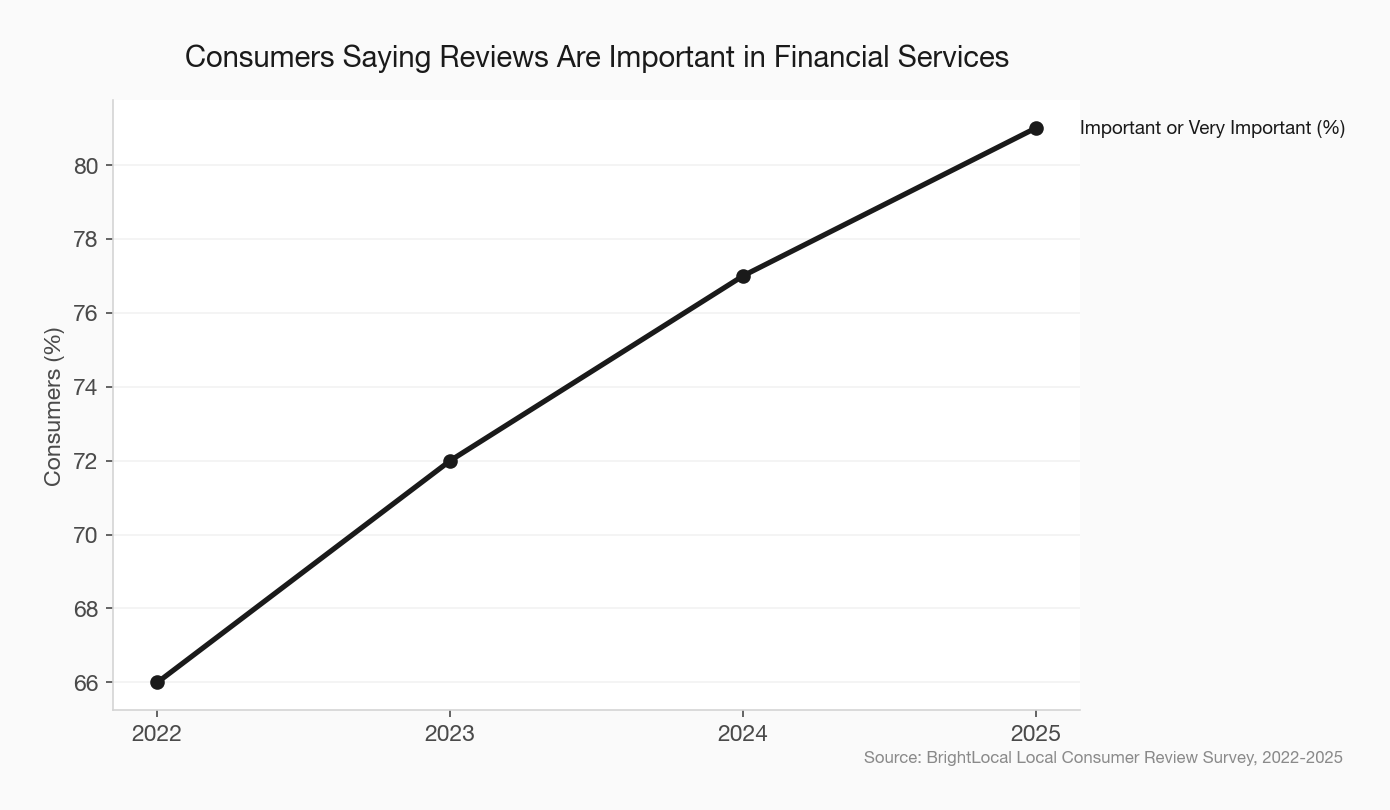
Eighty-one percent of consumers now say reviews are “important” or “very important” when choosing a financial services provider – up from 66% in 2022. Eighty-three percent of consumers use Google to read reviews. And 89% expect the business to respond.
Translation: for a community bank, your review profile on Google is more important than your marketing brochure, more important than your branch signage, and arguably more important than your ad budget. It is also almost free to build.
The community banks that win here run a simple system:
- Ask systematically. After every account opening, loan closing, and major service interaction, a staff member texts a direct Google review link to the customer. Not “please leave us a review.” Send the link. Remove the friction.
- Respond to every review. Every one. Positive, negative, and the weird ones. The response is for the searcher reading reviews three months from now, not the reviewer. Professional, specific, signed by a name.
- Target 50 minimum. The 50-review mark is where Google starts treating you as a prominent local business. The bank with 11 reviews from a decade looks dead. The bank with 180 reviews and fresh responses looks alive.
This is the highest-ROI marketing activity available to a community bank, measured in dollars spent to accounts opened. It is also the one most banks will not commit to because it requires the staff to do something slightly outside their job description. That hesitation is the opportunity.
community bank online reputation management
The Location Page Nobody Writes
If your bank has more than one branch, each branch needs a dedicated, indexable location page on your website. Not a PDF. Not a map pin. A real page with:
- The branch address and phone number, matching the GBP exactly
- Hours, including drive-through and lobby separately
- Staff names and photos (this matters more than you think)
- Services offered at that specific branch
- An embedded Google Map
- Local content – events, sponsorships, community ties specific to that location
- Schema markup for LocalBusiness and FinancialService
Community bank websites typically have one “Locations” page with a list. That page is invisible for the query “[branch name] [city].” A dedicated page per branch is the difference between showing up for geographically specific searches and not.
This is a day of content work, not a website rebuild. And it pays for itself on the next account open.
The Citation and NAP Audit
Your bank is listed on dozens of directories you have never thought about: Yelp, Yellow Pages, Foursquare, Bing Places, Apple Maps, Better Business Bureau, credit union aggregators, financial directories. Each one has a name, address, and phone number. If any of them is wrong, Google sees the inconsistency and loses confidence in your location.
Run a citation audit once a year. Tools like BrightLocal, Moz Local, or Yext will crawl the major directories and flag inconsistencies. Fix them in batches. This is not glamorous work. It is also exactly what your competitors are not doing, which is why it matters.
One acquisition or rebrand in your bank’s history and your citations are almost certainly polluted with a prior name, a closed branch address, or a discontinued 800 number. Clean it up.
What to Actually Measure
Stop measuring website sessions as the primary local SEO metric. Start measuring these:
- Local pack appearances for your core queries – “bank near me,” “small business loan [city],” “mortgage lender [county].” Track monthly with a rank-tracking tool or manual spot checks from mobile devices in different ZIP codes.
- GBP actions – calls, website clicks, direction requests. Your Google Business Profile dashboard shows this. Anything trending up is working.
- Share of local search. What percentage of “bank + [your city]” related queries show your bank in the top 3? If your share of local search is under 30%, you have runway. If it’s over 70%, you are doing real work.
- Review velocity. New reviews per month. Target 10+ per branch per month once the system is running.
- Account opens attributed to local search. Ask every new customer the single question: “How did you find us?” Track responses. This is the closest thing to real attribution you will get in banking.
community bank marketing metrics that matter
The 30-Day Local SEO Sprint
If you are starting from zero, this is the sequence:
Week 1. Claim and audit every Google Business Profile for every branch. Fix primary categories, add secondary categories, list every service, update hours, upload 20+ photos per branch. Claim listings on Bing Places, Apple Maps, and Yelp.
Week 2. Run a citation audit. Export a list of every directory citation and note inconsistencies. Start fixing the top 20 by traffic volume.
Week 3. Build the review system. Create a Google review link for each branch. Give staff a scripted text-message template. Set a weekly review goal per branch. Start responding to every existing review.
Week 4. Build a dedicated location page for each branch on your website. Include schema markup. Write 300 words of branch-specific content per page.
This is a one-person project, achievable with existing tools, on an existing budget. There is no platform to buy. There is no agency to hire. There is only the decision to do the work.
community bank 30-day marketing sprint
The Unfair Advantage Community Banks Keep Wasting
Large national banks rank nationally. Fintechs rank on branded queries. Community banks have one ranking surface where they can structurally win – local search in their geographic footprint – and most of them are not even showing up for it.
Your branch is in a specific place. Your customers are physically nearby. Your staff knows the community. Google’s local algorithm is built to surface exactly this kind of business. The only reason a fintech with no branch, no relationship, and no local presence outranks you for “small business loan [your city]” is that your bank did not spend two afternoons fixing its Google Business Profile.
The banks that will own local search five years from now are the banks doing the unglamorous work this month – cleaning up categories, fixing NAP, asking for reviews, publishing location pages. Nobody will write a case study about it. Boards will not ask about it. It is invisible internally and visible everywhere it matters.
That is the definition of an underused channel. Stop underusing it.
community bank website conversion optimization