Your Bank Has a Story. Here's How to Find It in 30 Minutes
A practical 30-minute exercise any community bank can run to uncover its brand narrative. Three interviews, three data points, one story. No agency required.
Seventy-seven percent of community bank CEOs say their greatest business opportunity in 2025 is differentiating their bank from competitors. Yet most of them are still running the same brand playbook: a stock photo of a handshake, a tagline about “community values,” and a website that could belong to any of the 4,500 community banks in America.
The differentiation problem isn’t a mystery. It’s a storytelling problem. And the fix doesn’t require an agency, a six-month branding initiative, or a board retreat in Scottsdale. It requires 30 minutes, three conversations, and a willingness to write down what you actually find.
Here’s the exercise.
Why Most Community Bank Brand Stories Fall Flat
Before we get to the exercise, let’s name the problem clearly. Most community banks default to one of three brand narratives, all of which are functionally identical: “We’ve been here since 1907,” “We know your name,” or “We’re not a big bank.”
None of these are stories. They’re claims. And they’re claims that every other community bank in your market is also making. When Adrenaline Inc. ran a branding workshop at ICBA’s LEAD FWD Summit, they put it bluntly: banks try to say everything about every product, and the result is that they say nothing memorable at all.
The real issue is specificity. A brand story isn’t a mission statement. It’s a concrete, particular narrative about who you serve, what you’ve made possible, and why that matters in your specific market. Gulf Coast Bank & Trust figured this out with their “Let’s Make It Happen” campaign — they stopped talking about products and started telling stories about specific local business owners who achieved specific goals with the bank’s help. The result was measurable growth.
Fairfield County Bank in Connecticut took a different route. They sponsored hyperlocal business profiles on HamletHub, a community news site, putting names and faces to the small businesses they serve. The bank reported record growth in the quarter they launched the initiative.
These banks didn’t hire McKinsey. They told specific stories about specific people. That’s the whole playbook.
The 30-Minute Brand Story Exercise
This exercise is designed for a single person — a CEO, a marketing lead, or anyone with enough institutional knowledge to answer honestly. You can also run it as a team exercise with 2-3 people in a room. The goal is not to produce a final brand message. The goal is to produce the raw material that a brand message gets built from.
You need a blank document and a timer. That’s it.
Minutes 1-10: Three Interviews (Or Three Memories)
If you can grab three people in your bank right now — a loan officer, a teller, and a customer — ask each of them one question:
“What’s one thing this bank did for someone that a bigger bank wouldn’t have done?”
Write down what they say. Not the polished version. The actual story, with names, dates, and details.
If you can’t grab three people in the moment, answer from memory. Think about three specific customers — not customer segments, not personas, actual people — and write down what happened. The baker who got the SBA loan after Chase turned her down. The nonprofit that needed bridge funding in 48 hours. The family that refinanced their farm during a drought.
The key word is specific. If your story could be told by any bank in any town, it’s not your story yet.
Minutes 11-18: Three Data Points
Now pull three numbers that make your bank’s impact concrete. These should take less than 10 minutes to find, because they’re sitting in systems you already have.
Pick three from this list:
- Total small business loans funded in your county last year (dollar amount)
- Number of local businesses you currently bank
- Percentage of deposits that stay in the local community as loans
- Number of years your longest-tenured employee has been at the bank
- Average time from loan application to decision (compared to the national average)
- Number of first-time homebuyers you helped last year
- Total community sponsorships or donations in the past 12 months
These numbers aren’t for a press release. They’re for grounding your story in proof. When 89% of Americans say they’re satisfied with their primary bank — according to the ABA’s Fall 2025 Morning Consult survey — satisfaction alone isn’t a differentiator. Your specific impact is.
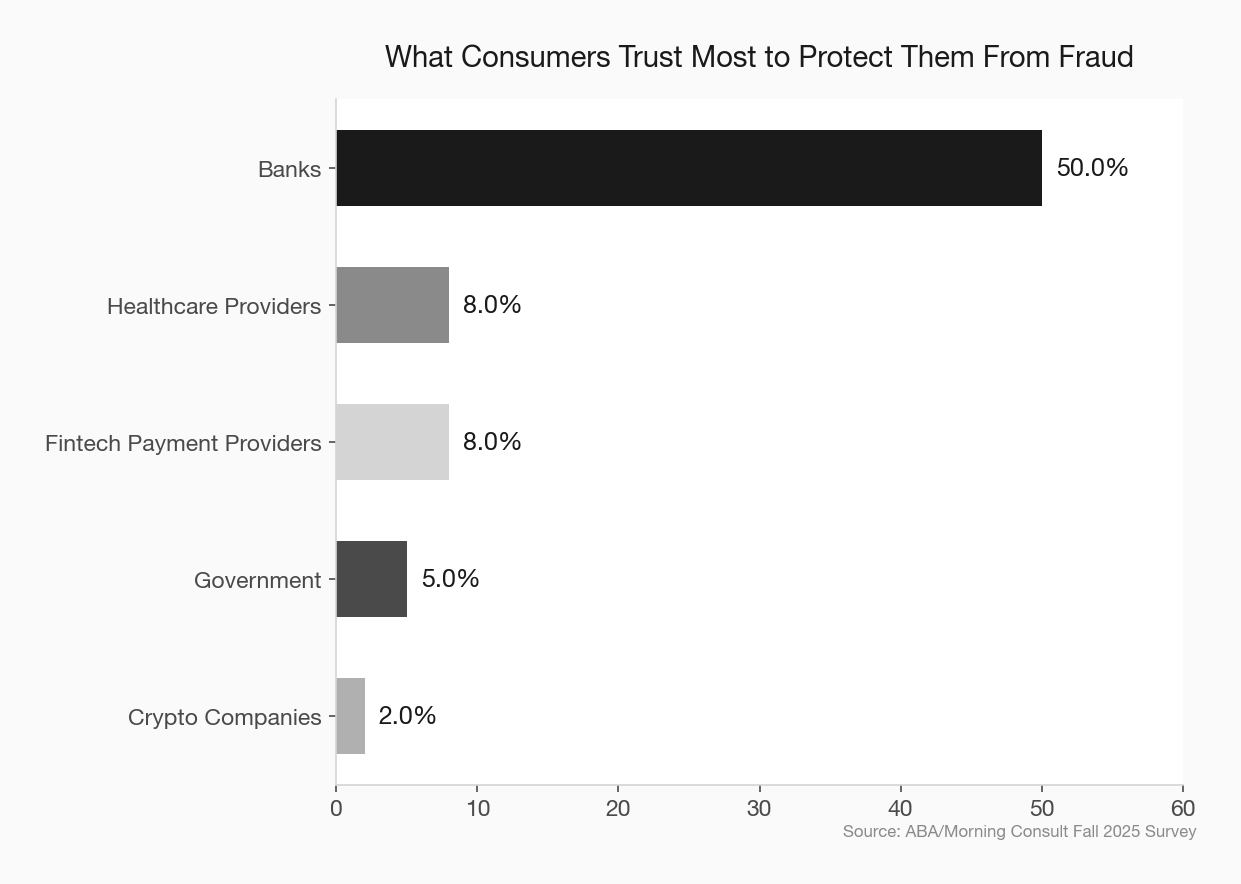
Community banks already win on trust. Fifty percent of U.S. adults trust banks more than any other entity to protect them from fraud — more than healthcare providers, fintechs, and the government combined. The problem isn’t trust. The problem is that trust without a story is invisible.
Minutes 19-25: Draft the Narrative
Now connect the dots. Take your three stories and three data points and write a single paragraph that answers this question:
“In [your town], [your bank] is the bank that _____.”
Fill in the blank with something so specific that no competitor could credibly claim it. Not “cares about the community.” Not “puts people first.” Something like:
- “In Tupelo, First Peoples Bank is the bank that funded 43 small businesses last year — including the coffee shop on Main Street, the pediatric clinic on Oak, and the construction company that rebuilt the elementary school after the tornado.”
- “In Bend, Cascade Community Bank is the bank where loan decisions happen in 24 hours because the person making the decision lives three blocks from the person asking.”
- “In Baton Rouge, Gulf Coast Bank is the bank that helped 200 local business owners get from ‘what if’ to ‘let’s go’ — and then told their stories so the whole city could see what’s possible.”
This paragraph is your brand story draft. It’s not finished. But it contains three things that 90% of community bank marketing lacks: real names, real numbers, and a real point of view.
Minutes 26-30: The Gut Check
Read your paragraph out loud. Then ask yourself three questions:
- Could a competitor say this exact thing? If yes, you’re not specific enough. Go back to the stories and find the detail that’s uniquely yours.
- Would a customer recognize their experience in this? If no, you’ve drifted into marketing-speak. Ground it back in what actually happened.
- Does this make you feel something? Not “does it sound professional.” Does it make you proud, or excited, or even a little emotional? People are 22 times more likely to remember a fact when it’s embedded in a story that moves them.
If your paragraph passes all three tests, you have something most community banks don’t: a brand story that’s actually yours.
What to Do With Your Story Once You Have It
A brand story sitting in a Google Doc is worth nothing. Here’s how to put it to work, starting this week.
Rewrite your website’s homepage headline. Most community bank homepages open with something like “Welcome to [Bank Name] — Your Community Bank Since 1952.” Replace it with a version of your one-paragraph story. Banks that redesign their websites around narrative and conversion consistently see better results — because 60% of account research starts online, and your homepage is the first story a prospect reads.
Turn each customer story into a social media post. Not a testimonial graphic with a stock photo. A real story, told in 3-4 sentences, with the customer’s permission. Fairfield County Bank’s HamletHub approach works because it centers real people, not product features. community bank social media strategy
Use your data points in every pitch. When a prospect asks “why should I bank here,” don’t answer with a feature list. Answer with: “Last year we funded $12 million in small business loans in this county alone. Here are three of those businesses.” Numbers plus names beats a brochure every time.
Brief your frontline staff. Your tellers and loan officers are your most frequent brand ambassadors. Give them the one-paragraph story and the three data points. When a customer asks “what makes you different,” they should have an answer that’s specific, confident, and true. community bank employee brand training
The Agencies Don’t Want You to Know This Is Simple
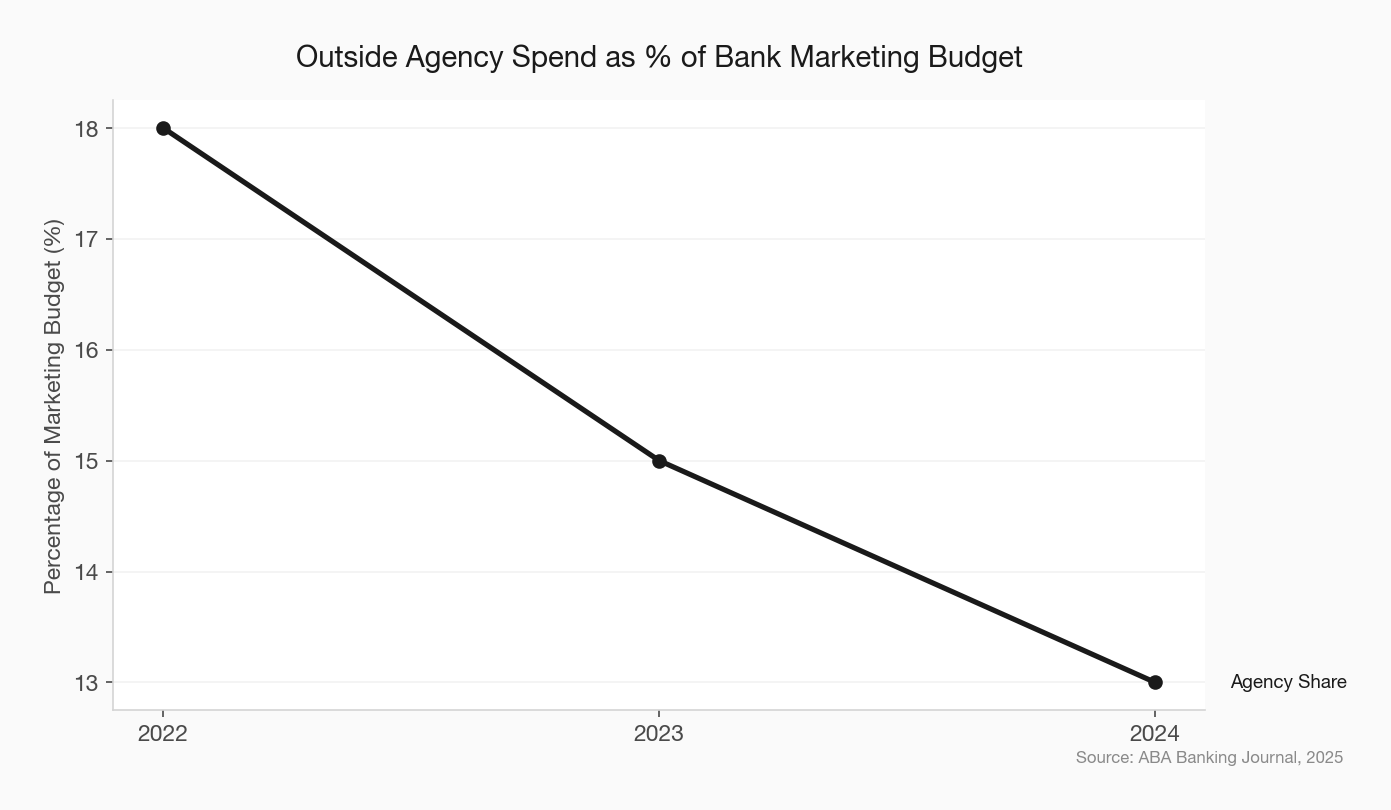
The average community bank spends between 0.05% and 0.07% of assets on marketing. For a $500 million bank, that’s $250,000 to $350,000 a year. A significant chunk of that goes to outside agencies — though that percentage has dropped from 18% to 13% of marketing budgets between 2022 and 2024, according to ABA data.
Agencies have their place. But brand discovery — the process of figuring out what your story actually is — shouldn’t be outsourced. No consultant knows your customers’ names. No agency sat in the room when you approved the loan that saved the hardware store. No outside firm can feel the weight of what it means to be the last locally-owned bank in your county.
The exercise above takes 30 minutes. It costs nothing. And it produces the one thing that fintechs, megabanks, and digital challengers cannot replicate: a true story, rooted in a real place, about real people.
Community banks hold a unique position in the American financial system. They fund 60% of small business loans. They employ local people. They make decisions based on relationships, not algorithms. But in a market where fintechs have captured 44% of new checking accounts by offering $500 sign-up bonuses, the relationship advantage only works if people know about it. community bank fintech competition strategy
Your bank has a story. It’s sitting in the memories of your loan officers, in the gratitude of your customers, in the data your systems already track. The only thing missing is the 30 minutes it takes to write it down.
So close the door, open a blank document, and start with the question: “What’s one thing this bank did for someone that a bigger bank wouldn’t have done?”
The answer is your brand. community bank brand differentiation Tellas brand strategy resources